Pixel art OCs: Claire
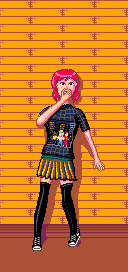
Characters:

This was a rather quick attempt to draw something in the style of UFO 50, a collection of 50 original games by Mossmouth, all made in a style reminiscent of 8-bit console games, sharing a single 32-color palette.
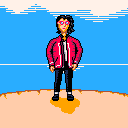
This one ended up looking a bit goofy in my opinion. I spent most of my attention on the jacket, which was slightly inspired by one I saw on my way from work.
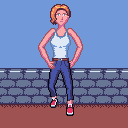
This is the first full-body image. I was (and am) still struggling with maintaining proper proportions and posing, which is part of why most of these images once again use front-facing perspective. Unlike most of these images, which use the PICO-8 palette, this one was an experiment with the Anb16 palette.

Was browsing through the community page of a game on Steam, happened to see someone’s profile pic of an elf-like character from some MMORPG with purplish gray hair, and it gave me a tiny bit of inspiration to draw something similar. I did make little pixel art portraits before, but these were usually in a front-facing perspective.

Okay, so last month (December of 2025), I saw a few screenshots of PC-98 games and went wondering: “in comparison, why do Western home computer games of the same era (the kind that you’d see on an Amiga or Atari ST) tend to be so ‘meh’-looking?”, in comparison to both console games of the same era and PC games that would come out shortly after games like DOOM would prove the PC was actually a viable mainstream gaming platform?".
A lot of the time, our preferences for what an OS user interface should look like come down, ultimately, to either nostalgia or past experiences. Someone gets annoyed at a UI change and their instinctive reaction is to assume that whatever “the old way” was, was inherently better.
This especially applies to people who use Linux (or any of the BSDs, but for purposes of this page, I’ll refer to any of the “free desktops” as Linux), since it is rarely ever their first operating system – usually they started off with either Windows or macOS, and picked up habits and assumptions from that.
I have recently developed a small library and command-line utility in Rust that opens and creates GXT files from older Grand Theft Auto games. GXT files (description of format) are binary-based lists of localizable text strings that are used both by the game’s executable and all the game/mission scripts. Since the games are meant to be released in different languages, using a separate format for storing strings makes sense.
The program supports, and was tested on, files from GTA III, Vice City and San Andreas, and should also work with the “Stories” games, which are based on Vice City’s engine.
I’ve decided to write a little script using JS that reads a Japanese notation for a move in shogi and tries to convert it into English.